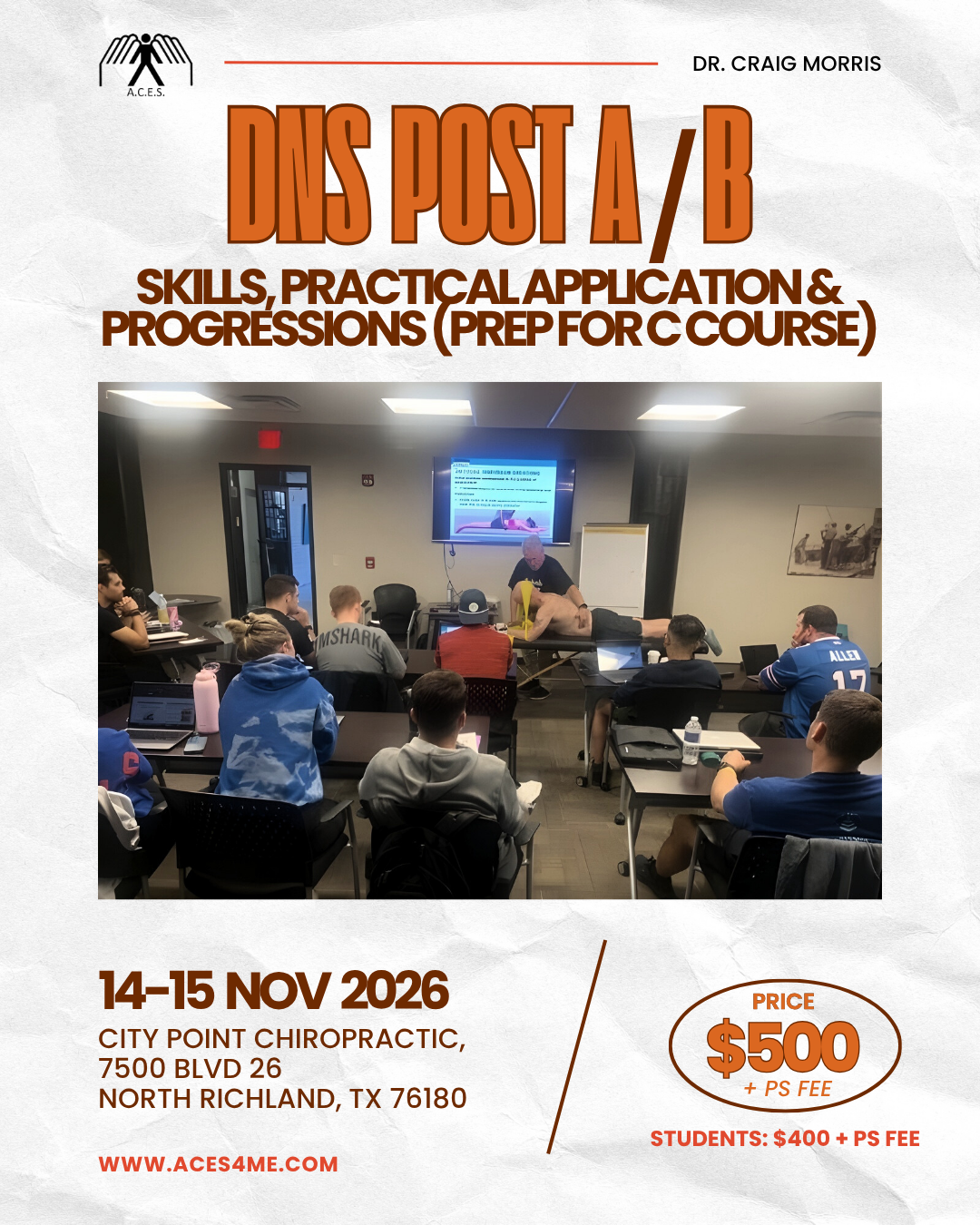
This chiefly hands-on course is designed as a clinical practical continuation and expansion of the registrant’s skillset following the completion of the DNS A and B courses after DNS students have had the opportunity to practically apply DNS methods with their own cases. This can be a critical period to gain greater understanding and skills with utilizing work-shopping and case examples.
The A course provides introductory instruction in the foundational DNS principles and skills utilizing non-differentiated motor patterns. The B course provides introductory instruction in the foundational DNS principles and skills utilizing differentiated motor patterns. This course provides a bridge between the A/B courses and the DNS C course and also assists with a better understanding and practical skillset for DNS specialty courses.
Course objectives:
- Briefly basic principles of developmental kinesiology, emphasizing development during the first year of life.
- Demonstrate the relationship between development during the first year of life and pathology of the locomotor system in adulthood.
- Define ideal postural stabilization from a developmental perspective: intra-abdominal pressure regulation, the dual role of the diaphragm in stabilization and respiration, and stabilization via co-contraction.
- Correction strategies for common stereotypes of faulty postural stabilization (“open scissors syndrome,” forward drawn posture, backward drawn posture, “hourglass syndrome”).
- Practically integrate the biomechanics of undifferentiated, ipsilateral and contralateral postural-locomotion patterns; closed and opened kinematic chains, stepping forward and supporting function in clinical practice.
- Evaluate and correct poor respiratory patterns and integrate the corrected patterns in a broader therapeutic model.
- Assess the integrated stabilizing system of the spine visually and by utilizing dynamic functional tests.
- Integrate corrective more advanced exercises based on the DNS functional tests and developmental positions: exercise in developmental-kinesiologically integrated static positions; position transfer during locomotor function; exercise progression using unstable surfaces; increased difficulty of the exercises utilizing resistance, dual tasking and other challenges.
- Demonstrate how DNS corrective exercises can integrate with other exercise strategies and progression.
- Cover the intermediate application of the DNS concept in sports training.
- Provide intermediate clinical management explanations for clinicians to better integrate the DNS approach in their regular practice, including patient education.
- Provide more complex clinical management reasoning for clinicians to better integrate more advanced DNS protocols into clinical practice beyond those taught in the B Course.
- Optimally prepare students for the next level of training (Course “C)
- Utilize case examples, including diagnoses for clarification, for more practical complex DNS application.
- Further prepare the student for all Specialized DNS courses.
Earn CE Credits in Your State
Please Note: The continuing education hours offered for this course are approved for Doctors of Chiropractic (DC) ONLY in the 35 states listed below. This includes PACE & CCE approved credits.
Alaska, Colorado, Connecticut, Delaware, Idaho, Illinois, Indiana, Iowa, Kansas, Maine, Maryland, Massachusetts, Michigan, Minnesota, Missouri, Montana, Nebraska, New Hampshire, New Jersey, New York, North Carolina, North Dakota, Ohio, Oregon, Rhode Island, South Carolina, South Dakota, Utah, Vermont, Virginia, Washington, Washington, DC, and Wyoming.
Although we do not have pre-approved continuing education (CE) hours for any other licensed health-care providers and/or any other states, we can provide upon request a certificate of course hours completed that may be acceptable to other state/professional CE boards.
Registration:
NOTE: Registration must be completed in two (2) parts.
- Submit the form and payment below as part one and
- Then move on to the second part with the link below for the Prague School Certification payment.
Part 1: Payment Form
Part 2: Prague School Payment Form
Click here to submit the Prague School Payment registration. (Required for Course Attendance, Notes & Certification)